

What is Magento PWA? Progressive Web Apps for Ecommerce
[Updated: April 01, 2026]
Mobile devices account for over 70% of all ecommerce traffic. Yet most Magento stores still serve clunky mobile experiences that lose customers before checkout.
Progressive Web Apps solve this. This guide covers what Magento PWA is, how it works, which solutions exist in 2026 (PWA Studio, ScandiPWA, Hyvä), and what it costs to build one.
Key Takeaways
- Magento PWA delivers app-like speed, offline access, and push notifications without requiring an app store download
- PWA Studio (v14.5.0) remains Adobe's official toolkit, but ScandiPWA and Hyvä Theme offer strong alternatives
- Hyvä Theme (open-source since November 2025) scores 100/100 on PageSpeed and reduces page weight by 86% compared to Luma
- PWA architecture relies on service workers, a web app manifest, app shell pattern, HTTPS, and GraphQL APIs
- AliExpress saw a 104% conversion rate increase for new users after adopting PWA
- Development costs range from $15,000 to $80,000+ depending on complexity and approach
- PWA replaces the need for separate iOS and Android native apps, cutting long-term maintenance costs by up to 40%
What is Magento PWA?
Magento PWA = A web application that combines website reach with native app performance on Magento stores. Users get fast load times, offline browsing, and push notifications without downloading anything from an app store.
Perfect for: High-traffic Magento stores, mobile-first businesses, merchants wanting app-like UX without native app costs
Not ideal for: Small stores with minimal mobile traffic, businesses needing deep hardware access (GPS, NFC, Bluetooth)
A Progressive Web App (PWA) sits between a traditional website and a native mobile app. It loads in the browser like a regular page but behaves like an installed application. Users can add it to their home screen, receive push notifications, and browse cached pages offline.
For Magento store owners, PWA means one codebase serves both desktop and mobile. No separate iOS and Android apps. No app store approval process. No forced updates. The storefront loads fast, works on any device, and updates itself in the background.
Adobe Commerce and Magento Open Source both support PWA through official tooling and third-party frameworks.
Benefits of Magento PWA
Faster load times. PWAs cache assets through service workers. Repeat visits load in under one second. This matters because bounce rates jump 32% when page load exceeds three seconds.
Offline access. Service workers store pages and product data on the device. Users can browse catalogs and view product details without an internet connection. Orders sync when connectivity returns.
Push notifications. Re-engage customers with order updates, price drops, and abandoned cart reminders. Push notifications on Android achieve higher engagement rates than email.
Cross-device compatibility. One PWA works on phones, tablets, and desktops. No platform-specific builds. No separate maintenance.
Add to home screen. Users save the PWA to their home screen with one tap. No app store needed. The icon sits next to native apps, and the PWA launches in full-screen mode.
Better Core Web Vitals. PWAs score higher on Google Lighthouse and PageSpeed metrics. Faster pages rank higher and convert better.
Lower total cost. Building one PWA replaces two native apps (iOS + Android). Businesses report up to 40% reduction in long-term development and maintenance costs compared to maintaining native apps alongside a website.
PWA Architecture: How It Works
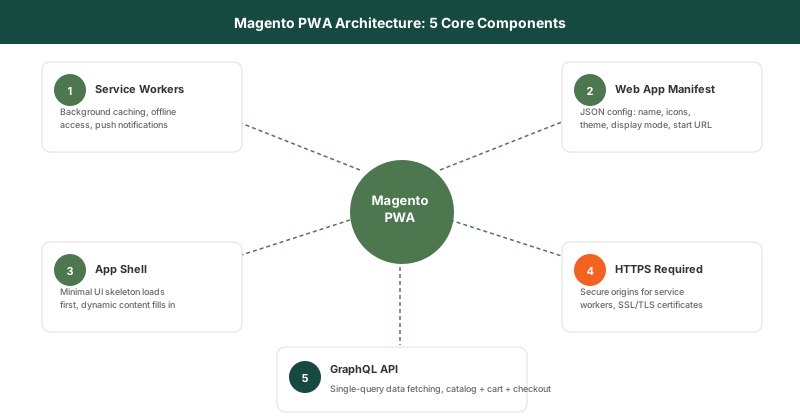
A Magento PWA consists of five core components that work together to deliver the app-like experience.
Service Workers
Service workers run in the background, separate from the main browser thread. They intercept network requests, cache responses, and serve cached content when the network is unavailable. This is what enables offline functionality and instant repeat-visit loads.
Web App Manifest
A JSON file that tells the browser how the PWA should behave when installed. It defines the app name, icons, theme colors, display mode (fullscreen, standalone), and start URL. This is what makes "Add to Home Screen" work.
App Shell Architecture
The app shell is the minimal HTML, CSS, and JavaScript required to render the UI skeleton. It loads first and caches on the device, while dynamic content fills in afterward. This creates the perception of instant loading.
HTTPS Requirement
PWAs require HTTPS for all connections. Service workers only run on secure origins. This means your Magento hosting must support SSL/TLS certificates, which any production hosting provider includes by default.
GraphQL API
Modern Magento PWAs use GraphQL instead of REST APIs. GraphQL lets the frontend request only the data it needs in a single query, reducing payload size and network round-trips. Adobe Commerce 2.4.x includes full GraphQL coverage for catalog, cart, checkout, and customer operations.
PWA Solutions for Magento in 2026
Four main approaches exist for building a Magento PWA storefront.
Magento PWA Studio (v14.5.0)
Adobe's official toolkit, released on GitHub under the magento/pwa-studio repository. The latest version (14.5.0, February 2025) includes improved robots meta tags, canonical link generation, and Live Search integration.
PWA Studio uses React and provides the Venia reference storefront as a starting point. It supports Adobe Commerce Cloud and Magento Open Source 2.4.x.
Best for: Teams comfortable with React who want Adobe's official, supported solution.
ScandiPWA
An open-source PWA theme maintained by scandiweb. ScandiPWA replaced the 100KB React library with 5KB Preact in recent versions, cutting frontend framework overhead by 95%. It runs on Node v20 and supports Magento 2.4.7+.
ScandiPWA works as a Magento theme (not a separate frontend application), which simplifies deployment and hosting.
Best for: Teams who want a ready-made PWA theme with minimal configuration.
Hyvä Theme (Performance Alternative)
Hyvä takes a different approach. Instead of building a separate JavaScript frontend, it replaces Magento's Luma theme with a lightweight Alpine.js and Tailwind CSS stack.
Since going open-source in November 2025, Hyvä has become the fastest-growing Magento frontend option. The numbers speak for themselves:
| Metric | Luma (Default) | Hyvä Theme |
|---|---|---|
| Page weight (uncompressed) | 3 MB | 0.4 MB |
| PageSpeed score | 30-50 | 100/100 |
| Core Web Vitals | Fails | Passes all |
| JavaScript dependencies | ~300 | ~10 |
Hyvä is not a PWA in the traditional sense. It does not provide offline access or push notifications out of the box. But it delivers the speed and UX benefits that most merchants want from a PWA, without the complexity of a decoupled architecture.
Best for: Merchants who want PWA-level performance without going headless.
Vue Storefront
An open-source framework that uses Vue.js for the frontend. It connects to Magento through a middleware layer and supports multiple ecommerce backends. Vue Storefront suits teams already invested in the Vue.js ecosystem.
Best for: Multi-platform businesses that may switch backends in the future.
PWA Studio vs Hyvä: Choosing the Right Approach
This is the most common question Magento merchants face in 2026. The answer depends on your priorities.
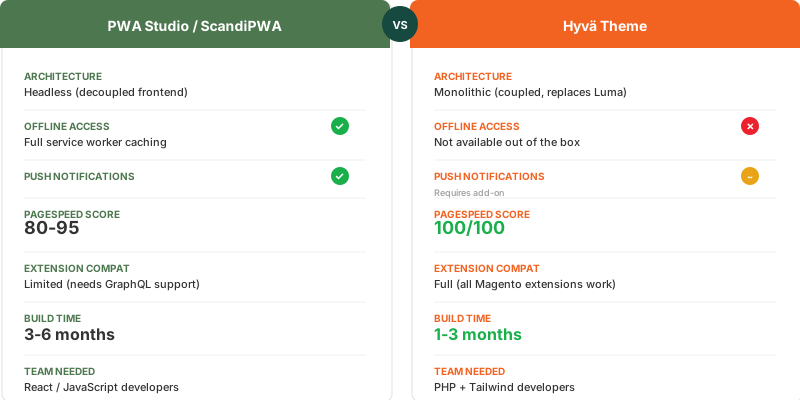
| Factor | PWA Studio / ScandiPWA | Hyvä Theme |
|---|---|---|
| Architecture | Headless (decoupled) | Monolithic (coupled) |
| Offline access | Yes | No |
| Push notifications | Yes | Requires add-on |
| PageSpeed score | 80-95 | 95-100 |
| Development complexity | High | Medium |
| Magento extension compatibility | Limited (needs GraphQL) | Full compatibility |
| Team requirement | React/JS developers | PHP + Tailwind developers |
| Deployment | Separate frontend hosting | Same server as Magento |
| Typical build time | 3-6 months | 1-3 months |
Choose PWA Studio or ScandiPWA if you need offline functionality, push notifications, or plan to serve the same frontend across multiple backends.
Choose Hyvä if you want the best performance scores, full extension compatibility, faster time to market, and a simpler architecture. Most Magento stores in 2026 choose Hyvä for this reason.
Real-World Results: PWA Case Studies
AliExpress (2018)
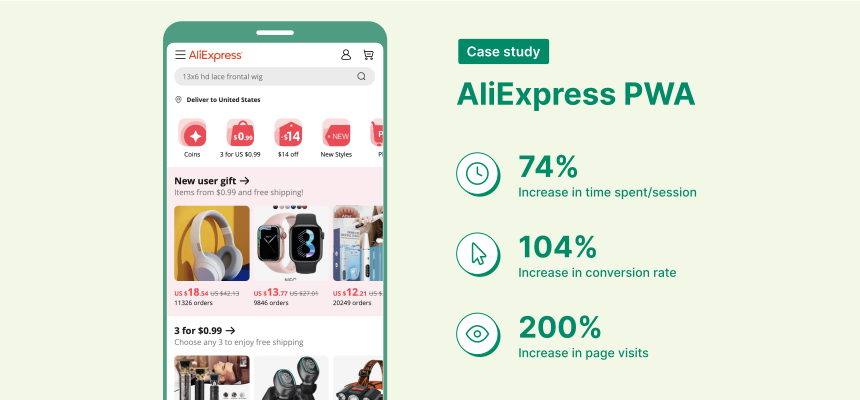
AliExpress was one of the first major ecommerce platforms to adopt PWA. The results set the benchmark for mobile commerce transformation:
- 74% increase in time spent per session across all browsers
- 104% increase in conversion rate for new users
- 200% increase in pages visited per session
These results came from replacing their mobile website with a PWA that loaded in under two seconds, even on slow 3G connections (source: web.dev case study).
Eleganza (Netherlands)
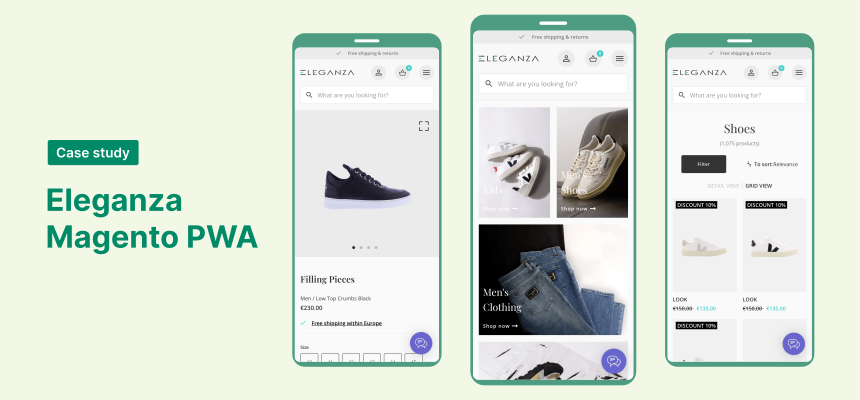
Eleganza, a high-end fashion retailer in the Netherlands, transitioned to Magento 2 with a PWA storefront after discovering 90% of their customers browsed on mobile devices.
Key improvements after the PWA launch:
- Responsive design optimized for thumb-reachable navigation
- Icon-based category sections for cleaner visual hierarchy
- Scrollable product gallery with touch gestures
- First meaningful paint under 1.5 seconds on mobile
Magento PWA Development Costs in 2026
Development costs depend on the approach, team location, and project scope.
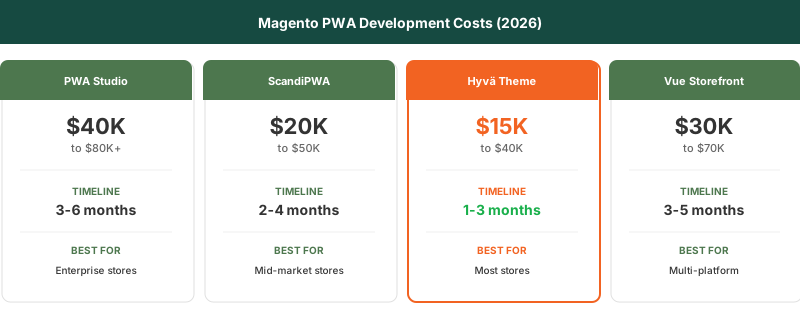
| Approach | Estimated Cost (2026) | Timeline | Best For |
|---|---|---|---|
| PWA Studio (custom build) | $40,000-$80,000+ | 3-6 months | Enterprise stores |
| ScandiPWA (theme-based) | $20,000-$50,000 | 2-4 months | Mid-market stores |
| Hyvä Theme | $15,000-$40,000 | 1-3 months | Most stores |
| Vue Storefront | $30,000-$70,000 | 3-5 months | Multi-platform businesses |
Developer hourly rates range from $30 to $150 depending on region and expertise. Eastern European and South Asian agencies offer lower rates, while US and Western European agencies charge premium rates for Magento-specific PWA expertise.
Hidden costs to budget for: GraphQL API customization for custom modules, QA testing across devices, performance optimization, and ongoing maintenance (plan 10-15% of build cost per year).
PWA Trends Shaping Magento in 2026
AI-powered personalization. PWA frontends now integrate AI-driven product recommendations, predictive search, and dynamic content personalization. These features process data on the edge, reducing latency.
GraphQL-first architecture. The shift from REST to GraphQL APIs is complete for new builds. Adobe Commerce 2.4.8 expands GraphQL coverage to include B2B features, staged content, and advanced catalog permissions.
Omnichannel integration. PWAs connect with POS systems, social commerce platforms, and marketplace channels through unified APIs.
Edge rendering. Platforms like Cloudflare Workers and Vercel Edge Functions bring server-side rendering closer to users, cutting Time to First Byte below 100ms for global audiences.
Sustainability. Lighter PWA frontends consume less bandwidth and processing power. This aligns with EU CSRD reporting requirements for Scope 3 digital emissions.
Magento PWA vs Native Apps
| Feature | Magento PWA | Native App |
|---|---|---|
| Platform support | iOS + Android (one codebase) | Separate builds per OS |
| Installation | Add to home screen (one tap) | Download from app store |
| Updates | Automatic (transparent) | Manual via app store |
| Offline access | Yes (cached pages) | Yes (full local storage) |
| Push notifications | Android: Yes, iOS: Yes (since iOS 16.4) | Full support |
| Hardware access | Limited (camera, GPS) | Full (NFC, Bluetooth, sensors) |
| Development cost | $15,000-$80,000 (one build) | $50,000-$150,000+ (two builds) |
| Maintenance cost | Lower (one codebase) | Higher (two codebases + store fees) |
| App store approval | Not needed | Required (delays possible) |
| SEO visibility | Full (indexable by Google) | None (app content not indexed) |
For most Magento merchants, PWA is the practical choice. Native apps make sense only when deep hardware access (NFC payments, Bluetooth beacons, AR with device sensors) is a core requirement.
Pros and Cons of Magento PWA
FAQ
What is Magento PWA? Magento PWA is a Progressive Web App built on top of Adobe Commerce or Magento Open Source. It delivers an app-like experience through the browser with fast load times, offline access, and push notifications.
Is Magento PWA Studio free? Yes. PWA Studio is open-source and free to use. It is available on GitHub under the magento/pwa-studio repository. The latest version is 14.5.0 (February 2025).
What is the difference between Magento PWA and Hyvä? PWA Studio creates a separate, decoupled JavaScript frontend (headless). Hyvä replaces the default Luma theme with a lightweight monolithic frontend. Hyvä is simpler to build and maintain, while PWA offers true offline access and push notifications.
Does Magento PWA work on iOS? Yes. Since iOS 16.4 (March 2023), Safari supports Web Push notifications for PWAs. Add-to-home-screen has worked on iOS since Safari 11.3.
How much does a Magento PWA cost to build? Costs range from $15,000 for a Hyvä-based build to $80,000+ for a custom PWA Studio implementation. The main cost drivers are design complexity, custom module GraphQL support, and team location.
Can I convert my existing Magento store to a PWA? Yes. ScandiPWA works as a Magento theme and installs on top of your existing store. PWA Studio requires building a separate frontend application. Hyvä replaces your theme files but keeps the same Magento backend.
Does Magento PWA improve SEO? Yes. PWAs score higher on Core Web Vitals (LCP, FID, CLS), which are Google ranking factors. PWA content remains indexable by search engines, unlike native app content.
What are the system requirements for Magento PWA Studio? PWA Studio requires Node.js 14 or higher, Yarn 1.12 or higher, and a Magento 2.4.x backend. The backend must serve GraphQL endpoints over HTTPS.
Is PWA Studio being deprecated? No. Adobe continues to maintain PWA Studio with regular releases. Version 14.5.0 shipped in February 2025 with bug fixes and documentation updates.
Should I choose PWA or a native app for my Magento store? Choose PWA if you want lower costs, one codebase, and SEO visibility. Choose a native app only if you need deep hardware access like NFC payments or Bluetooth beacon integration.
Summary
Magento PWA transforms how online stores deliver mobile experiences. Whether you choose PWA Studio for full headless capabilities, ScandiPWA for a ready-made theme, or Hyvä for maximum performance with minimal complexity, the investment pays off through faster load times, better conversion rates, and lower maintenance costs.
The right choice depends on your technical team, budget, and whether offline access matters for your customers. For most Magento merchants, starting with Hyvä and adding PWA features as needed offers the best balance of cost and performance.
Ready to upgrade your store's frontend? Explore managed Magento hosting built for high-performance storefronts.
